
People trying to gain muscle often search for a macro tracker for muscle gain because calories alone do not answer the question they care about most: “Am I eating enough protein and enough total food to support my training?”
Macro tracking provides a simple structure for answering that question, but the value comes from consistency rather than obsessing over exact numbers.
What are macros?
Macronutrients are protein, carbohydrates, and fats. They provide energy and play different roles in the body. For muscle-focused users, protein usually receives the most attention because it provides amino acids needed for muscle protein synthesis.
Carbohydrates can support training performance and replenish glycogen, while dietary fats are important for normal physiological functions. The ideal balance varies by person and goal.
Start with total intake and protein
A complicated macro plan is unnecessary if you are not consistently eating enough total food or protein. Many strength-focused users therefore start by monitoring two things: total energy intake and daily protein.
An app can make those patterns visible, but the target itself should be appropriate for the individual. If you need personalized nutrition advice, consult a registered dietitian or another qualified professional.
Why a modest surplus is easier to manage
Muscle gain does not require turning every meal into a maximum-calorie challenge. A very large surplus can increase body weight faster without guaranteeing a proportional increase in muscle.
Tracking can help you notice whether intake is consistently above, below, or around your intended range, especially when combined with training and body-weight trends.
Protein distribution can be easier to see with a tracker
A daily protein total is useful, but the meal-by-meal view can reveal patterns. Someone may eat very little protein at breakfast and lunch, then try to make up the entire target at dinner.
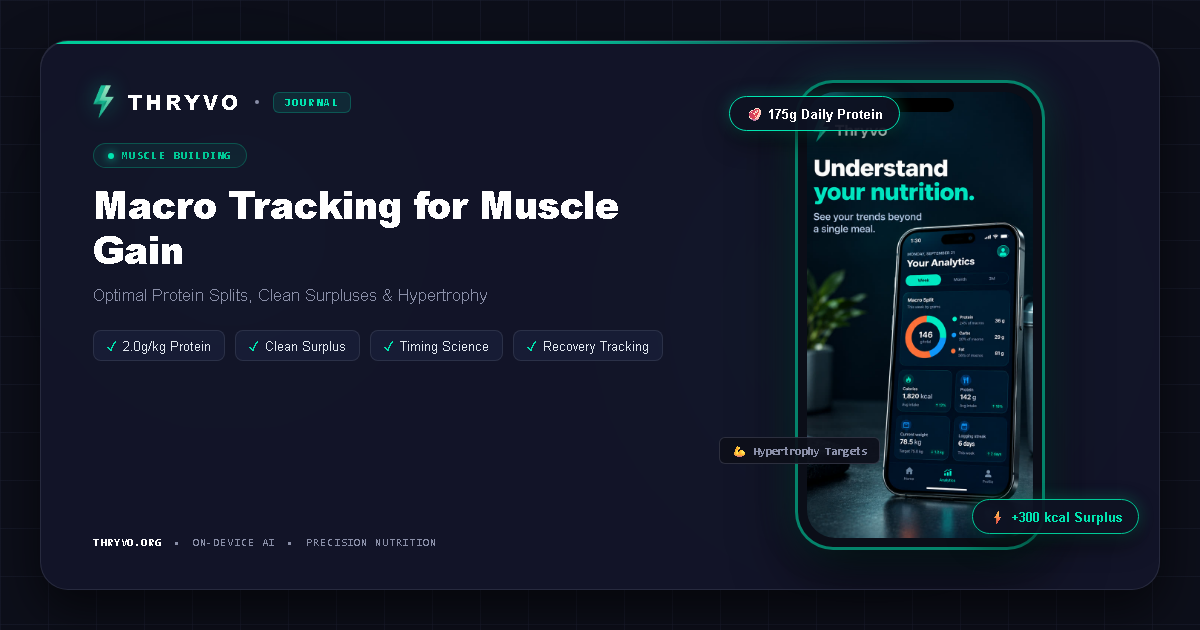
A clear macro dashboard helps users spread intake in a way that fits their schedule.
Photo logging reduces friction
Bulking meals can be large and contain several components. Manually searching every ingredient becomes tedious. A photo-based tracker can create a draft entry from the plate, then let the user correct portions and hidden ingredients.
This is especially helpful when the goal is not laboratory-grade precision but consistent awareness over weeks and months.
What a muscle-gain tracker should show
A useful interface should make these values easy to find:
- Daily calorie intake relative to your target.
- Protein total and remaining amount.
- Carbohydrate and fat totals.
- Body-weight trend if you choose to track it.
- Workout history or training consistency.
- Water or recovery-related habits if those are part of your routine.
The app should not force you to open five different screens to answer “How am I doing today?”
Training still drives the adaptation
Nutrition supports muscle growth, but resistance training provides the stimulus. A macro tracker cannot replace a progressive training plan.
This is where a product that combines nutrition tracking with workout tools becomes interesting. Thryvo says it is building food scanning and macro tracking alongside AI posture analysis and workout logging in the same free app.
Do not confuse tracking with accuracy
Every calorie and macro entry is based on source data and portion size. Restaurant meals, homemade recipes, and visual estimates can vary. Use the tracker consistently, review long-term body-weight and performance trends, and adjust thoughtfully rather than reacting to one day.
Frequently asked questions
Do I need to track all three macros to gain muscle?
Not necessarily. Some people primarily track calories and protein. Others find a full macro breakdown helpful for planning meals and training fuel.
Can AI estimate protein from a food photo?
If the app identifies the food and estimates a portion, it can map that entry to nutrition data containing protein. The result remains an estimate and should be editable.
Is a calorie surplus required for muscle gain?
Energy intake is one factor in muscle gain, but the appropriate intake depends on the person and training context. Avoid using a generic app target as personalized medical or nutrition advice.
Bottom line
A macro tracker for muscle gain should make it easier to answer a few practical questions: Are you eating enough overall? Are you consistently getting protein? Are your habits supporting your training?
Thryvo is building a free fitness app that brings photo-based nutrition tracking and workout-form coaching into one experience.
Sources and editorial notes
- Thryvo Support: https://thryvo.org/support.html (free-forever positioning, planned device support, on-device posture processing)
- Thryvo: https://thryvo.org/
- MyFitnessPal Free/Premium/Premium+ comparison: https://support.myfitnesspal.com/hc/en-us/articles/34889191368077-The-difference-between-Free-Premium-and-Premium
- MyFitnessPal Meal Scanner: https://support.myfitnesspal.com/hc/en-us/articles/360045761612-How-to-use-the-Meal-Scanner
- MyFitnessPal Barcode Scanner: https://support.myfitnesspal.com/hc/en-us/articles/360032624771-How-to-use-the-Barcode-Scanner
- Cal AI App Store listing: https://apps.apple.com/us/app/cal-ai-calorie-tracker/id6480417616
Health note: This article is educational and is not medical or individualized nutrition advice. AI food estimates, app calculations, and camera-based form feedback can be imperfect.