
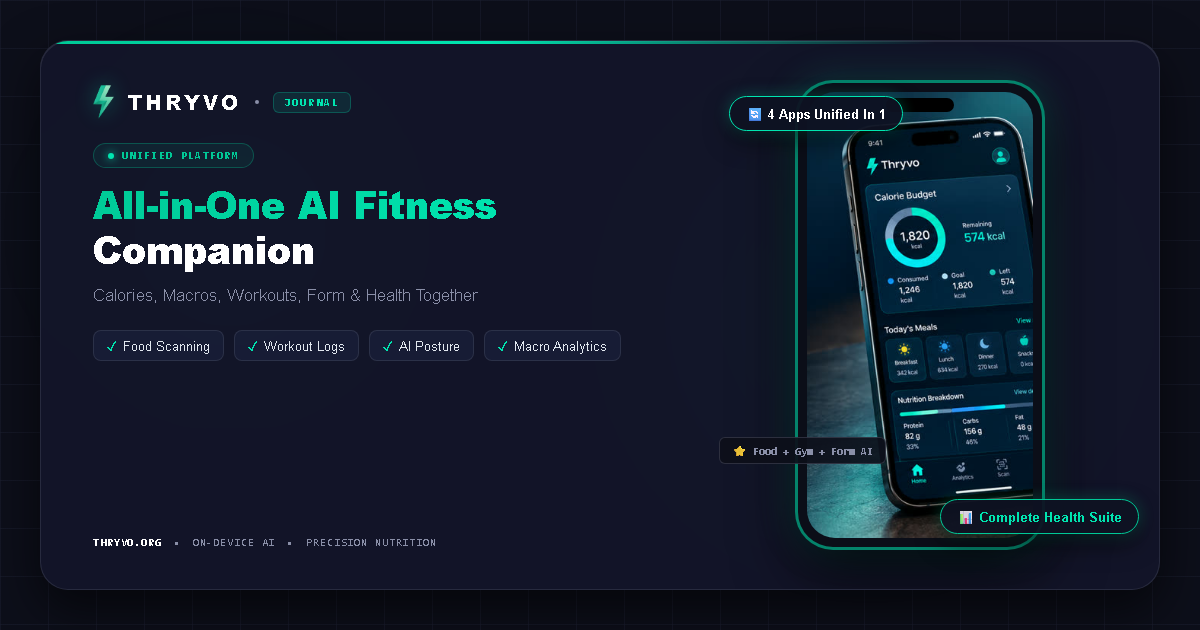
Fitness routines are often split across several apps: one for calories, another for workouts, another for water, another for progress photos, and perhaps a camera tool for exercise form. An all-in-one fitness tracker tries to reduce that fragmentation.
The idea sounds convenient, but combining features only helps if the product remains simple. Ten mediocre dashboards are not better than three useful ones.
The core jobs an all-in-one app should solve
1. Log food quickly
Nutrition tracking should not require a long database search for every meal. Photo-based AI can reduce that friction by creating an editable meal estimate.
2. Show calories and macros clearly
The daily view should answer basic questions immediately: calories consumed, target range, protein, carbohydrates, and fats.
3. Track workouts without interrupting them
Exercise logging should be fast enough to use between sets. Timers, sets, repetitions, and notes should not require excessive navigation.
4. Provide form feedback when requested
Camera-based posture analysis can add value when the user wants help reviewing movement. It should be optional and explain how camera data is processed.
5. Keep hydration and habits visible
Water and streak tracking are simple features, but they are useful when presented without clutter.
6. Turn daily entries into trends
A dashboard should help users see patterns over time instead of displaying only today’s numbers.
Why the all-in-one model can reduce friction
Every additional app creates another account, interface, notification system, privacy policy, and potential subscription. Consolidation can make a routine easier to manage.
The trade-off is complexity. A broad fitness product needs strong information architecture so the user can ignore features they do not need.
AI should remove steps, not add novelty
An app does not become useful simply because it includes AI. AI has value when it shortens a repetitive task or provides information that would otherwise be difficult to access.
Two strong examples are food-photo logging and camera-based movement feedback. In both cases, AI can convert visual input into a structured result.
A free model changes how users experiment
Thryvo says its planned app will offer all features free, without paid tiers, subscriptions, ads, or paywalls. That includes food photo scanning, posture detection, water tracking, and workout logging.
For an all-in-one product, that is significant because the user does not have to decide which module is “worth upgrading.” They can try nutrition tracking, form coaching, and habit tracking as part of the same system.
Privacy becomes more important as features expand
A product that handles food photos, workout camera input, goals, and progress data has a responsibility to explain its data practices clearly.
Thryvo says its posture analysis runs locally on the device and does not stream workout video to its servers. That local-processing model is particularly relevant to camera-based features.
Users should still review the complete privacy policy for account and analytics data, not only the AI feature.
What to avoid in an all-in-one fitness app
Feature overload
If the home screen shows every possible metric, the app becomes harder to use. Good design prioritizes the next useful action.
Hidden subscription dependencies
If the main reason for using an all-in-one app is consolidation, discovering that several core modules require separate upgrades defeats part of the purpose.
False precision
AI meal estimates and wearable metrics should be presented as useful estimates, not unquestionable measurements.
Generic coaching
Workout feedback should be specific to the exercise and camera setup. Vague advice is less useful than one clear cue tied to a visible pattern.
Who benefits most from one fitness app?
Beginners often benefit because they do not need to assemble a complex software stack. Busy users may value fewer steps and fewer accounts. Students and budget-conscious users may prefer a free platform. Privacy-conscious users may care about local AI processing. Travelers may value offline behavior.
The common theme is reduced friction.
Frequently asked questions
What should an all-in-one fitness tracker include?
At minimum, the product should make its core promise easy to use. For a nutrition-and-training app, that may include food logging, calorie and macro summaries, workouts, progress, and optional coaching features.
Is an all-in-one app better than specialized apps?
Not always. Specialized tools may offer deeper functionality. An all-in-one product is most useful when convenience and consistency matter more than specialized complexity.
Can one app use AI for both food and workouts?
Yes. Computer vision can be applied to different tasks such as food recognition and pose estimation, although the models and workflows are different.
Bottom line
The best all-in-one fitness tracker should feel simpler than using several separate apps. Food logging should be fast, workout tracking should stay out of the way, form coaching should be optional and clear, and privacy should be easy to understand.
Thryvo is building that combined model around a free-forever product with on-device AI, meal scanning, posture feedback, workouts, water, goals, and progress tracking.
Sources and editorial notes
- Thryvo Support: https://thryvo.org/support.html (free-forever positioning, planned device support, on-device posture processing)
- Thryvo: https://thryvo.org/
- MyFitnessPal Free/Premium/Premium+ comparison: https://support.myfitnesspal.com/hc/en-us/articles/34889191368077-The-difference-between-Free-Premium-and-Premium
- MyFitnessPal Meal Scanner: https://support.myfitnesspal.com/hc/en-us/articles/360045761612-How-to-use-the-Meal-Scanner
- MyFitnessPal Barcode Scanner: https://support.myfitnesspal.com/hc/en-us/articles/360032624771-How-to-use-the-Barcode-Scanner
- Cal AI App Store listing: https://apps.apple.com/us/app/cal-ai-calorie-tracker/id6480417616
Health note: This article is educational and is not medical or individualized nutrition advice. AI food estimates, app calculations, and camera-based form feedback can be imperfect.